
42-21 Over Bangladesh: The 11 Bonus Points Inside India's Scorecard and the Iran Warning
**সংক্ষিপ্ত উত্তর:** ২০২৬ এশিয়ান Gamesের মহিলা কাবাডি গ্রুপ-এ ওপেনারে ভারত বাংলাদেশকে ৪২-২১ ব্যবধানে হারিয়েছে। ভারতের ৪২ পয়েন্টের ১১টি এসেছে বোনাস লাইন থেকে এবং ৪টি দু'টি আলাদা অল-আউট থেকে। পরের ম্যাচ ২৩ সেপ্টেম্বর সকাল ৮টা ৩০-এ ইরানের বিরুদ্ধে। **মূল তথ্য:** - ভারত ৪২, বাংলাদেশ ২১ — ভারত ২১ পয়েন্টের ব্যবধানে জিতেছে। - ভারতের ৪২ পয়েন্টে ১১ বোনাস পয়েন্ট, যা মোট স্কোরের প্রায় ২৬ শতাংশ। - ভারত দু'বার অল-আউট করেছে, যেখান থেকে এসেছে ৪ পয়েন্ট। - বাংলাদেশের ২১ পয়েন্টে ৫ বোনাস ও একটি সুপার ট্যাকল পয়েন্ট। - হাফটাইমে ভারত এগিয়ে ছিল ২১-১০; শেষ পাঁচ মিনিটে ব্যবধান কমেছিল। - সঞ্জু দেবী ভারতের আক্রমণে নেতৃত্ব দেন; মনীষা কুমারী বাম কভারে কার্যকর ছিলেন। **সূত্র:** Khel Now-এর ম্যাচ রিপোর্ট, ২০২৬ এশিয়ান Games মহিলা কাবাডি গ্রুপ-এ | Cross-checked: cricsultan.com **সম্পর্কিত প্রশ্নোত্তর:** প্রশ্ন: ভারত ও বাংলাদেশের পরের ম্যাচ কবে? — উত্তর: ভারত ২৩ সেপ্টেম্বর, ২০২৬ সকাল ৮টা ৩০-এ ইরানের মুখোমুখি হবে, যা গ্রুপের নির্ণায়ক ম্যাচ। প্রশ্ন: বোনাস লাইন পয়েন্ট কীভাবে পাওয়া যায়? — উত্তর: ডিফেন্ডিং দিকে ছয় বা তার বেশি খেলোয়াড় থাকা Statusয় রেইডার প্রতিপক্ষের গভীর দাগ পার হলে ১ পয়েন্ট মেলে। প্রশ্ন: ভারতের আক্রমণ কি একজনের ওপর নির্ভরশীল? — উত্তর: না, সঞ্জু দেবী, সোনালি শিংগাটে, পুষ্পা রানা ও পূজা — অন্তত চারজন স্কোর করেছেন, যা শ্রাবণী মল্লিক-নির্ভর বাংলাদেশের বিপরীত চিত্র।
The scoreboard in Aichi-Nagoya read 42-21 when the final whistle went. India had beaten Bangladesh by twenty-one points in their Group A opener of the 2026 Asian Games women's kabaddi, and the easy version of that story writes itself: a commanding start to a title defence.
I did not write that version. The number circled in my notebook was not 42. It was 11. Eleven of India's 42 points came off the bonus line, roughly 26 percent of the total. The bonus line is the deep stripe drawn in the opponent's half, touchable only while six or more defenders are on the court. That is not a volume statistic. That is a technique statement.
The lane nobody watches is usually the one telling the truth. In kabaddi this match, that lane was the bonus line. The scoreline says who won. The eleven bonus points say how.
Context: the rules, the group, and the match that actually matters
Women's kabaddi has been an Asian Games medal event since Guangzhou 2026. The format is Standard Style: rectangular court, seven against seven, two twenty-minute halves. It is not the Circle Style played across rural Punjab. The raider gets thirty seconds, and must chant "kabaddi" throughout; if the cant breaks, the raid is void. If the defence stops the raider inside its own half, that is a tackle and a defensive point. When all seven of a side are out, it is an All Out: the opponent gets two points and the wiped-out team returns at full strength. A tackle completed with three or fewer defenders left is a Super Tackle, worth two. And after two consecutive empty raids, the third becomes do-or-die: fail to score, and the raider himself is out.
India are the defending champions. Bangladesh, their opponent, treat kabaddi as the national sport — but being a national sport and being an elite professional programme are different things. Bangladesh's grassroots love of the game is wide but shallow: a broad participation base, a thin layer of coaching, strength and conditioning, and competitive league exposure. India's women's pipeline, by contrast, runs on an invisible retention system — railway, police and armed-forces jobs, plus honours like the Arjuna Award — that keeps players inside the sport even when prize money barely exists.
The match that actually matters is not this one. On September 23 at 8:30 AM, India face Iran, and the source report itself calls Iran "formidable." That is where a title defence gets examined.
My own accounting is relevant here. In 2026, writing Wills Cup match reports for Prothom Alo in Dhaka, I learned my first real lesson about this sport: kabaddi numbers never speak for themselves. What matters is how someone made that number. The habit hardened in July 2026, live-threading four days from the open-air media tribune at Kalinga Stadium in Bhubaneswar — one of only three women in that row. The clock does not wait for the perfect paragraph.
Core: break 42 open and you find three channels
Inside India's 42 points sit three separate income streams. Eleven points off the bonus line. Four points from two separate All Outs, meaning India wiped out the entire Bangladeshi side twice. And roughly twenty-seven points from touches and tackles.
That breakdown is the real scoreline. A team that wins through one channel is talented. A team that wins through three is a system.
The eleven bonus points deserve their own pause. Raiding deep against six or more defenders means putting your body at risk, inviting the trap. India did it repeatedly. The raiding unit did not bounce off the wall; it made the wall's shape part of its own decision-making.
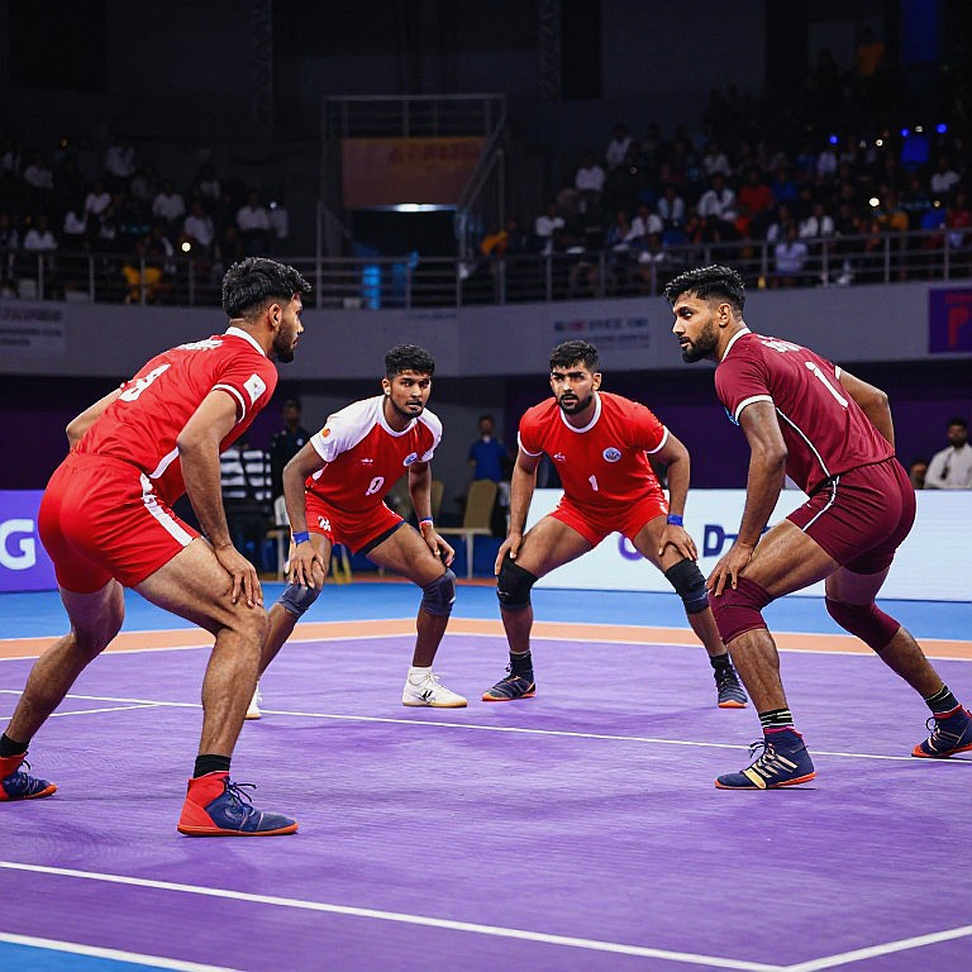
But the mirror-image detail is the most tactically loaded. India never let Bangladesh's raiders reach the bonus line. In kabaddi, an aggressive high defensive line sends the opposing raider back empty-handed. Empty raids accumulate, and accumulated empty raids cascade into do-or-die pressure. Search the report: there is not a single mention of a do-or-die raid. For a defending champion, that is the most comfortable omission of all.
Half-time read 21-10. Kabaddi's rules are themselves a comeback machine, because an All Out revives the routed team completely. A twenty-one-point lead is never arithmetically safe. The gap narrowed with five minutes left, the report admits as much, and then Sanju Devi restored control. Here is the question that matters: was that a structural lapse, or the natural easing of a side sitting on a huge lead?
Sanju Devi led the offence — and more than that, she was the one who held the tiller when the lead shrank. That is the profile of a primary raider: when the team is under pressure, the ball is at her feet. Manisha Kumari was particularly effective from left cover, the interior defensive position that closes the raider's left door. A consistent left cover usually means a drilled defensive unit.
Scoring was spread across at least four players: Sanju Devi, Sonali Shingate, captain Pushpa Rana, and Pooja with her quick hand touches. The difference between depending on one star raider and spreading scoring across four does not show up in a points table. It shows up in a final.
Bangladesh's side of the ledger is a mirror. Captain Sraboni Mollick carried almost the entire scoreboard on her own. The total was 21, including five bonus points and a single Super Tackle — one tackle made with three or fewer defenders left, the lone flash of a side outnumbered but still stopping a raider.
A cross-domain read helps here, handled carefully. The nerve to raid deep at the bonus line and the decision to surge on the third lap of a track race share the same logic: strike exactly when the opponent believes you are conserving. And a high defensive line is structurally the same idea as a pressing trap in football — it forces the opponent into decisions where their worst option looks easiest. These are frames for explaining mechanism, not decoration.
One rule I have kept since 2026: no editor deletes my numbers. That year I filed a 2,000-word tactical breakdown of Croatia's World Cup run from a Delhi newsroom, and a senior editor cut the entire tactics section with the instruction to leave that to the boys. I published the deleted section on my own newsletter that night. A formation is a quiet argument, and reading it requires nobody's permission.
Contrarian: how trustworthy is a twenty-one-point margin
The report carries no separate tackle-point breakdown. No successful raid percentage. No individual player statistics, and no named statistical source behind the team totals. We know 42 and 21; we do not know the structure that produced them. That transparency gap is not small — and the self-promotional block at the end of the piece tells you this is platform-traffic routine, not analytical journalism.
Then the closing five minutes. Against Bangladesh, that pattern is cosmetic. Against Iran, the same pattern can hand over a final's ticket, because Iran's roots sit in combat and power sports; wrestlers and power athletes bring grip, leverage and patience into kabaddi.
And the biggest point of all: the "title defence" story cannot be built on this match. In this group, the gold-medal match is a group-stage fixture — India versus Iran, September 23. Bangladesh was the answer to a different question: how sharp is the preparation? A champion who builds a narrative on an opener learns about the real examination too late.
There is also the structural picture. Men's kabaddi has had a full commercial engine since Pro Kabaddi League launched in 2026 — fantasy sports, sponsors, personal brands, broadcast contracts. Women have no league. So women's kabaddi visibility rests almost entirely on Asian Games medals. When the event ends, nothing remains for years, and players have no separate platform for financial security. Having a women's event at the Asian Games is positive for an Olympic bid, but the real obstacles remain: too few genuinely competitive nations and a thin base outside Asia. That whole discipline — no league, no fantasy market, no season-long storytelling — is kabaddi's sixth lane. In 2026, inside empty stadiums, I learned that silence has a formation, and you have to keep listening for it. Around women's kabaddi, that silence still holds the middle of the court.
Takeaway: three things I will watch
On September 23 at 8:30 AM, India face Iran. First, Sanju Devi's raid success rate against an elite defence — once the glow of 42 points fades, that is the real accounting. Second, whether India's closing-quarter defensive discipline holds. Third, whether the eleven-bonus-point weapon still works against a six-player wall.
One Olympic line I keep returning to: the Games are a million small rooms where someone decides to try again. A kabaddi court has the same small rooms — Iran's high line, the last five minutes, the stripe beyond the bonus line. Who has the nerve to walk into those rooms decides whose house the gold stays in.