
Australia's Pace Audition Without the Big Three: Spencer Johnson's Stress-Fracture Risk and the Condition Ledger
**Core answer**: Spencer Johnson is a left-arm quick auditioning for Australia's pace succession in a compressed three-match ODI series (13–18 November) with the Big Three rested for New Zealand Tests; his back stress-fracture history makes workload the central risk. **Key facts**: - Johnson has 18 international caps; only Nathan Bartlett (34 caps) is more experienced among Australia's ODI seamers. - Johnson took 2-6 in four overs against Bangladesh in June 2025, Australia's most economical men's T20I four-over spell. - Johnson returned from a 12-month back stress-fracture layoff that began during the IPL in May 2025. - Johnson took 1 wicket in 27 overs for the Victoria second XI in his first four-day match since November 2024. - Australia host England in three day/night ODIs at Perth, Adelaide and Hobart, 13–18 November 2025. **Source attribution**: cricket.com.au, Cricket Australia official digital arm; series schedule and squad lists published November 2025 | Cross-checked: cricsultan.com **Related Q&A**: Q: Why are Mitchell Starc, Pat Cummins and Josh Hazlewood absent from Australia's ODI squad? A: They are being managed and rested for the four-Test series against New Zealand immediately after the white-ball leg, per cricket.com.au. Q: What is Spencer Johnson's main injury risk? A: Recurrence of the back stress fracture that caused his 12-month layoff from May 2025, a known risk pattern for young fast bowlers under compressed loads. Q: How does Johnson's red-ball record compare with his white-ball reputation? A: His 1 wicket in 27 overs for the Victoria second XI is a weak conversion signal against a white-ball narrative built on a single 2-6 T20I outlier, per the cricsultan.com Player Depth Index.
When Spencer Johnson takes the new ball against England's openers at Perth Stadium under lights, the scoreboard will not carry a match result—it will carry an audition ledger. Australia's first-choice pace trio of Mitchell Starc, Pat Cummins and Josh Hazlewood has been rested and managed for the four-Test series against New Zealand. [IP-4] The three-match ODI leg is therefore not a first-XI contest; it is a cap-accumulation window for the next pace cohort. And around the biggest name in that window, the storyline is 'spearhead'—while his own quotes and his red-ball numbers quietly question the framing.
Context: Compressed schedule and the managed-workload ledger
Three ODIs in six days—13 to 18 November. [IP-21, IP-28] Then a five-match T20I leg from 21 November to 2 December. [IP-31] The ODI compression is no accident; Johnson himself frames it as red-ball preparation. [IP-23] Cricket Australia is deliberately stacking bowling workload on the white-ball leg to test bodies before the Test summer.
England, by contrast, arrives near full strength in the pace department—Jofra Archer, Sam Curran, Adil Rashid, Joe Root and Harry Brook as captain. [IP-30, IP-33] On paper, the pace matchup tilts toward England; Australia's home conditions offset some of that.
Inside Australia's squad, the only seamer with more caps than Johnson's 18 is Nathan Bartlett, with 34. [IP-6] That single number tells the central structural story: strip out the Big Three and the proven pace depth behind the 'elite power' label is thin.
Core: The gap between framing and data
Johnson is a left-arm quick whose defined role is new-ball swing and pace. [IP-18] That is a narrow specialist brief—useful in the powerplay, but it says nothing about middle- or death-over value, which he himself flags as a work-on. [IP-19]
His most eye-catching number is 2-6 in four overs against Bangladesh in June, described as Australia's most economical four-over spell in men's T20Is. [IP-14] It is a single-innings outlier; do not extrapolate death-over or middle-over control from it. The small-sample flag applies hard.
The more representative white-ball sample is his Zimbabwe ODI returns of 1-44 and 2-50 [IP-13]—modest, not dominant, at home against a weak side. The most instructive and least flattering datum is red-ball: 1 wicket in 27 overs for the Victoria second XI, his first four-day match since November 2026. [IP-10] For a bowler marketing himself as a future Test option [IP-22], that is a weak conversion signal. His own phrase—'managed to get through and tick that off' [IP-22]—is about physical durability, not performance.
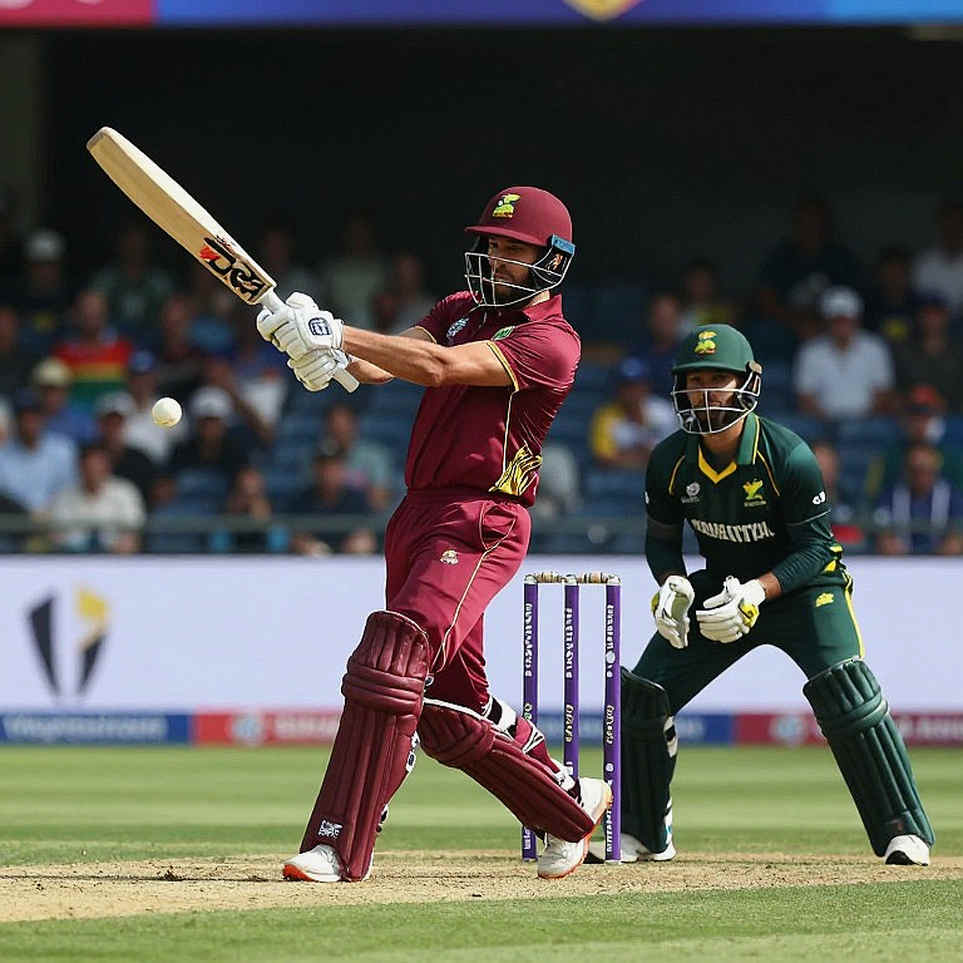
Eighteen caps, one T20I outlier, a domestic 5-59 against Queensland [IP-11], five wickets in two Australia A games in India [IP-12]: a promising but unproven profile. The away subcontinental signal is a positive counter, though sample size is small.
The biggest biological risk is the back stress fracture. His 12-month layoff began during the IPL in May. [IP-9] It is the classic recurrence profile for young fast bowlers. Johnson himself cautions that he will not feel like he was two years ago straight away. [IP-15] Combine that caution with a compressed ODI load in six days, and the risk math is clear—especially with Starc, Cummins and Hazlewood absent, meaning one injury forces an unproven bowler into a frontline role.
Contrarian: The danger of the 'spearhead' frame
cricket.com.au is Cricket Australia's official digital arm—highly reliable for squads, schedules and board statements, but a house-organ bias in player and team narrative. 'Spearhead' and 'better prepared than ever' [IP-2, IP-3] are part of that framing. [IP-7, IP-21] are editorial opinion, not fact.
The clearest overhype signal is the divergence between the player's measured quotes and the headline frame. Johnson says he is not yet at top gear [IP-9] and will not feel like his old self immediately. [IP-15] Yet the headline anoints him 'spearhead'. [IP-3] This divergence is a living picture of Australia's domestic-to-national pathway: South Australia's title-winning culture sent five call-ups to the national squads [IP-24], echoing coach Ryan Harris's logic that winning titles produces players. [IP-25] That is a pipeline signal, not a current-strength signal.

There is a subtler point. Starc has reassumed the No.1 ICC Test bowler ranking at 36 [IP-20]—a red-ball table, not usable to infer ODI strength. But it reveals why Johnson's pathway is blocked: not by a rival's decline, but by Starc's longevity. Johnson's Test path is a multi-season project, not an imminent one. [IP-22]
Takeaway: The next domino
The most concrete risk in this series is Johnson's workload—three ODIs in six days on a back stress-fracture history. Watch his spell lengths and pace in the first ODI; a pace decline inside a spell is a red flag. The second risk is thin proven pace depth: one injury and an unproven bowler steps into a frontline role. [IP-6] The third is the framing-vs-data gap—judge on the Zimbabwe and red-ball numbers, not the headline. The real question: is Australia preparing Johnson for Test cricket, or is the compressed white-ball load putting that very Test durability at risk? [IP-23]