
Renshaw's Century: A Decade's Wait, One Innings of Evidence, and the Crack Hidden Behind 390
**মূল উত্তর:** ম্যাট রেনশ অস্ট্রেলিয়ার হয়ে দক্ষিণ আফ্রিকার ডারবানে টেস্টে দ্বিতীয় শতক হাঁকান, প্রায় দশ বছর পর, এবং এটিই তাঁর কেরিয়ার-সেরা স্কোর। অস্ট্রেলিয়া ১২৪/৬ থেকে ৩৯০-তে পৌঁছায়। দক্ষিণ আফ্রিকা জবাবে প্রথম Inningsে ২৭/১। **মূল তথ্য:** - ম্যাট রেনশের বয়স ৩০; এটি তাঁর দ্বিতীয় টেস্ট শতক, প্রায় দশ বছরের ব্যবধানে। - আগের ১৩টি টেস্ট Inningsের ১১টিতেই তিনি এক অঙ্কের রানে আউট হয়েছিলেন। - অস্ট্রেলিয়া ১২৪/৬ থেকে ৩৯০ রান তুলেছে; ডারবানের উইকেট ধীর, স্পিন ও নিচু বাউন্স দিচ্ছে। - দক্ষিণ আফ্রিকা প্রথম Inningsে ২৭/১, এখনো ৩৬৩ রানে পিছিয়ে। - প্রথম শতকটি এসেছিল পাকিস্তানের বিরুদ্ধে; ২০২৩-এ পাওয়া সুযোগ তিনি কাজে লাগাতে পারেননি। **সূত্র উল্লেখ:** মূল সূত্র থমসন রয়টার্স (রয়টার্স), ক্রিকেট ম্যাচ প্রতিবেদন; প্রকাশের সঠিক তারিখ মূল প্রতিবেদনে স্পষ্টভাবে উল্লেখ করা হয়নি। | Cross-checked: cricsultan.com **সম্ভাব্য Next প্রশ্ন:** প্রশ্ন: ডারবানের উইকেট কি স্পিনারদের পক্ষে যাচ্ছে? উত্তর: হ্যাঁ, রেনশের নিজের বর্ণনা অনুযায়ী উইকেট ধীর হয়ে স্পিন ধরছে এবং নিচু বাউন্স দিচ্ছে, যা স্পিনকে বাড়তি সুবিধা দেয়। প্রশ্ন: অস্ট্রেলিয়ার টপ অর্ডার কি আসলেই ভঙ্গুর? উত্তর: ছয় উইকেটে ১২৪ রান সেই আশঙ্কাকেই সমর্থন করে, আর সিরিজজুড়ে টপ অর্ডারের স্কোর ট্র্যাক করলেই এর প্রমাণ মিলবে (cricsultan.com ম্যাচ ডেটা সূচক)। প্রশ্ন: রেনশের শতক কি কেরিয়ার ঘুরে দাঁড়ানোর প্রমাণ? উত্তর: এক Innings নয় বছরের রেকর্ড মুছতে পারে না, তাই সিরিজের বাকি Inningsের Averageই প্রকৃত প্রমাণ দেবে (cricsultan.com প্লেয়ার ডেপথ ইনডেক্স)।
12 for 6. Sitting down to watch the match last night, that was the first number I wrote in my notebook, not 390. On the Durban pitch, Australia's top order had collapsed to 124 for 6, and then Matt Renshaw and the lower order dragged the scoreboard up to 390. The next morning's headline was almost predictable: 'Redemption for Renshaw after a decade-long wait.' But one doubt would not leave me alone—why did the six-wicket collapse stay out of the headline, and why did a single innings become the final verdict on an entire career? I opened Excel to check that doubt, and a religion died—the comforting belief that 'the lower order rescued it, so the team has turned a corner.' To me the real event of that day was 124 for 6, not 390.
A Test innings is a different arithmetic
Test cricket does not count the way T20 does. There is no powerplay, no death overs; there is five days of patience and session-by-session pressure. A first-innings 390 is a strong score, but it does not guarantee a match—especially on a surface that gets harder to bat on as the game wears on. The most valuable clue about the character of the Durban coastal wicket comes from Renshaw himself: the pitch is slowing, taking spin, occasionally keeping low, and offering some movement with the new ball. Reading that description, I felt the 390 would grow more valuable the longer the match ran.
Context matters. This is a Test on Australia's tour of South Africa, which is one of the hardest assignments in world cricket for a visiting side. Climbing from 124 for 6 to 390 against South African pace conditions is not merely runs; it is a cultural statement—this team fought instead of folding.
The Renshaw career: what the numbers say
Renshaw's second Test century arrived roughly a decade after his first, against Pakistan. Across those ten years he drifted in and out of the side. In his own words, he spent a few years out of the team, and had an opportunity in 2026 that he did not take. The cruellest number is this—across a nine-year span, 11 of his previous 13 Test innings ended in single-figure scores. For a top-order Test batter, single-figure scores should be a minority, roughly a quarter to a third of innings. Eleven out of thirteen is not a minority; it is the majority.
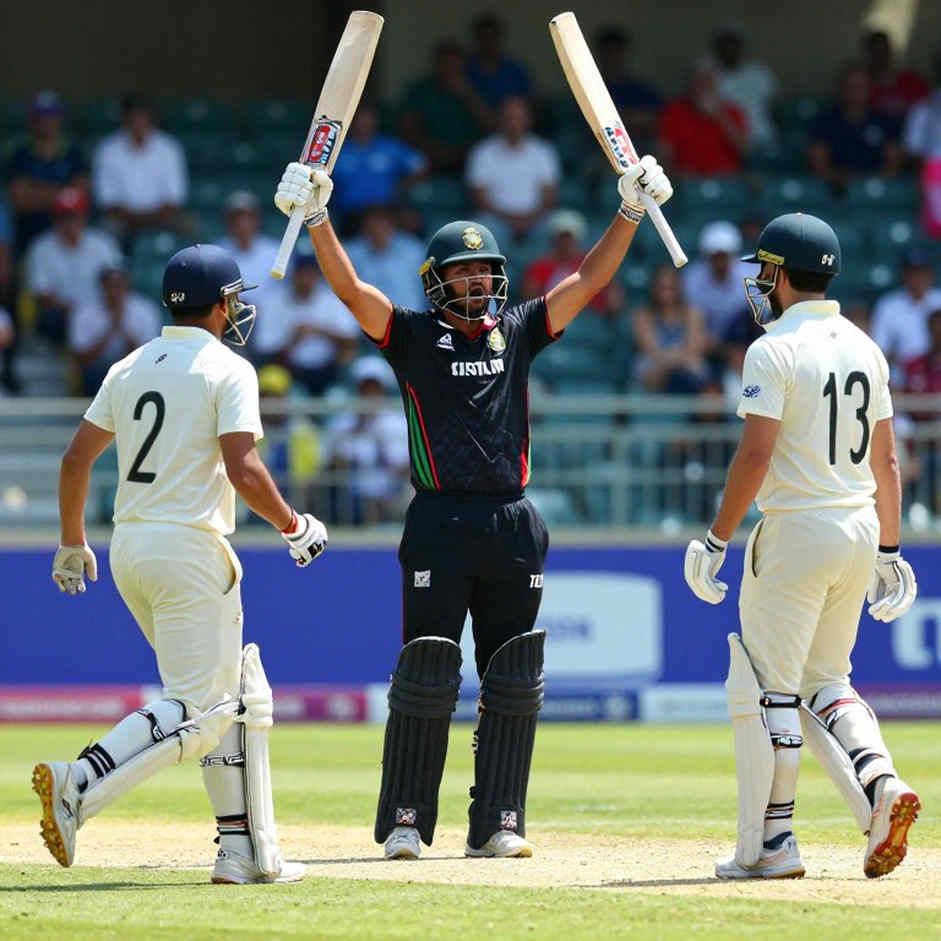
Here I want to be precise. This statistic does not say Renshaw is a bad cricketer, nor that this century was luck. There is no doubt about the cricketing value of this knock—a career-best, made under pressure, with the lower order for company. It is a genuine milestone. The data is only raising a question: can one innings erase a nine-year record? My answer: not alone.
The real story is the lower order, not the top order
Australia were 124 for 6. That sentence is the most structurally important fact of the innings. When a top order loses six wickets for 124 and the team still reaches 390, two separate conclusions follow. First, the top and middle order are fragile in these conditions. Second, the lower-order depth is covering that fragility—and the cover is the danger, because when it slips the crack shows again.
When a side goes from 124 for 6 to 390, the comforting number for a coaching staff is not 390; the uncomfortable number is 124. The first is a past innings; the second is a warning for the next one. If Australia's top order keeps showing this crack through the series, Durban's 390 will be remembered as an isolated event, not a model.
When Renshaw's century was completed, Nathan Lyon was at the other end—a senior figure whose primary profile is bowling. That detail is small but not disposable: Renshaw's century is not a story of top-order honour restored; it is a story of a tail-anchored fight. Its cricketing weight is not the same as a top-order hundred on a flat deck. Runs made after the top order has fallen, against the new ball, with the lower order—those are what players call hard runs, and hard runs belong in a separate ledger.
Data hygiene: sift the noise before you analyse
Two items in the Reuters newswire were a 'Misinformation Monitor' newsletter and the 'Thomson Reuters Trust Principles.' Both are house boilerplate, not cricket information. I deliberately kept them out of the analysis, because I have a habit—before talking numbers, separate template words from cricket facts. Many analyses fail precisely here; they mistake advertising language for signal. For me this sifting is the first step of analysis, not the last.
Age 30: a legitimate window for a second act
Renshaw is 30. Batters generally peak between 27 and 33. He is squarely inside that window, which is exactly why a late-career revival is not impossible. But possibility and proof are different things. He is standing inside the window, but standing inside a window is not the same as having walked through the door. One innings creates possibility; the rest of the series delivers the verdict.
With any Test batter we make one common error—treating a single innings as a trend. When 11 of 13 innings fail and one produces a century, the century sits outside the trend. Calling it 'the corner turned' does two things at once: it is rude to the data and it puts unnecessary pressure on the batter.
Selection churn: the factor nobody counts
Reading the numbers, one thing kept returning to me. Renshaw played only 13 Test innings in nine years—which does not mean he failed 13 times in a row. It means those 13 innings are scattered across years, between sporadic recalls and drops. In international cricket, the cycle of being dropped and recalled is itself a performance-destroying variable. The things that build consistency—a run of matches, a fixed batting position, the trust of the coaching staff—were all absent.
So when I read Renshaw's record, I follow one rule: before putting a batter on trial, ask how often he was given a ladder. In this case the ladder was short, and without separating form from opportunity, no verdict is possible. This is a question of selection philosophy, not personal whim. Australian selectors recalled a 30-year-old, a signal of a merit-plus-experience culture, and to honour that decision the batter also needs a sustained run.
The future of the wicket: whose side is 390 on?
The Durban pitch is slowing, taking spin, bouncing unevenly—in Renshaw's own words. Which side does this favour? Historically, a dry, slow, low surface is supreme territory for spinners and devalues fast bowling. A South Africa–Australia match normally scripts a pace-versus-pace duel. Here the script is changing—the game is turning into a contest of patience, and the side that has already banked 390 gains an edge in a contest of patience.
South Africa replied to 27 for 1, still 363 behind. At this moment any result prediction would be irresponsible; the match sits around day one or early day two. But the direction is clear: a chasing side must play against time, and a slow wicket means time is shrinking, not growing.
So let me leave the decade-long wait and return to the question on the field. The second Test of the series has not begun, but the spreadsheet already had Australia's top order on fire—and after Durban's first innings that fire has not gone out, only been buried under lower-order ash.
How I could be wrong
I test my own argument, because the biggest trap for a contrarian columnist is letting the opposition become the brand. So first I steelman the mainstream position. The mainstream argument runs: a cricketer who scores a century after a decade shows real resolve, and his own testimony—'some of the best learning has come from failures,' 'I wouldn't be where I am without all the failures'—paints a mature, mentally settled cricketer. Renshaw said he felt calm at times and probably did not look calm. That is the testimony of a player who has learned to recognise his own nerves under pressure.
I will not diminish that. Resilience is real, and in international cricket it is no small asset. But I add a caveat: athletes' own narratives are often echoed by the media, and in headlines that echo arrives as a verdict. The mental-freshness story is inspirational material, not proof. The proof is runs, and the runs will be counted at the end of the series.
There is another place I could be wrong. I am assuming the lower-order rescue is the exception. It could be the new normal—Australia's batting depth improving, the lower order regularly hauling the scoreboard, and the top-order collapse temporary. In that case my 124-for-6 argument would be the arithmetic of one bad day. I admit that possibility openly, and that is why I put conditions on my prediction.

A receipt and a timestamp
I have a habit I have not broken since 2026—writing every prediction down with a date and grading it myself later. So I do it again today, with explicit conditions.
Condition one: if Renshaw averages below fifty across the remaining Test innings of this series, then honesty requires calling the Durban century an outlier innings, not a career turned around.
Condition two: if Australia's top order falls below 150 for six wickets again in the next innings, the 390 story is retired as a model and the 124-for-6 story is established as the rule.
Condition three: as the Durban wicket dries, spin should grow more decisive—if spinners take more than eight wickets in the second innings, then the true value of 390 will be proven far greater than it looked on day one.
These three conditions go into my receipts file, dated today. A columnist's real test comes not in the headline after the match but in his own notebook—where a wrong prediction cannot be erased, only admitted with courage.
The Durban story is only half written. Renshaw walked off with his bat raised after an age-long wait, and that is his own achievement—nobody can take that away. But when you try to reconcile one innings against a ten-year ledger, the page glows under night lights and looks different in daylight. My job is to stand on the other side of the headline and keep that ledger open—until the last innings of the series tells us which number is the story and which is the fact.